Follow us on Google News (click on ☆)
To try to answer this question, a team of astronomers pointed the powerful Green Bank Telescope toward the comet. This instrument, associated with the Breakthrough Listen project, scrutinized 3I/ATLAS in search of technological signals. Significant resources were mobilized to determine if artificial radio emissions were coming from this object.
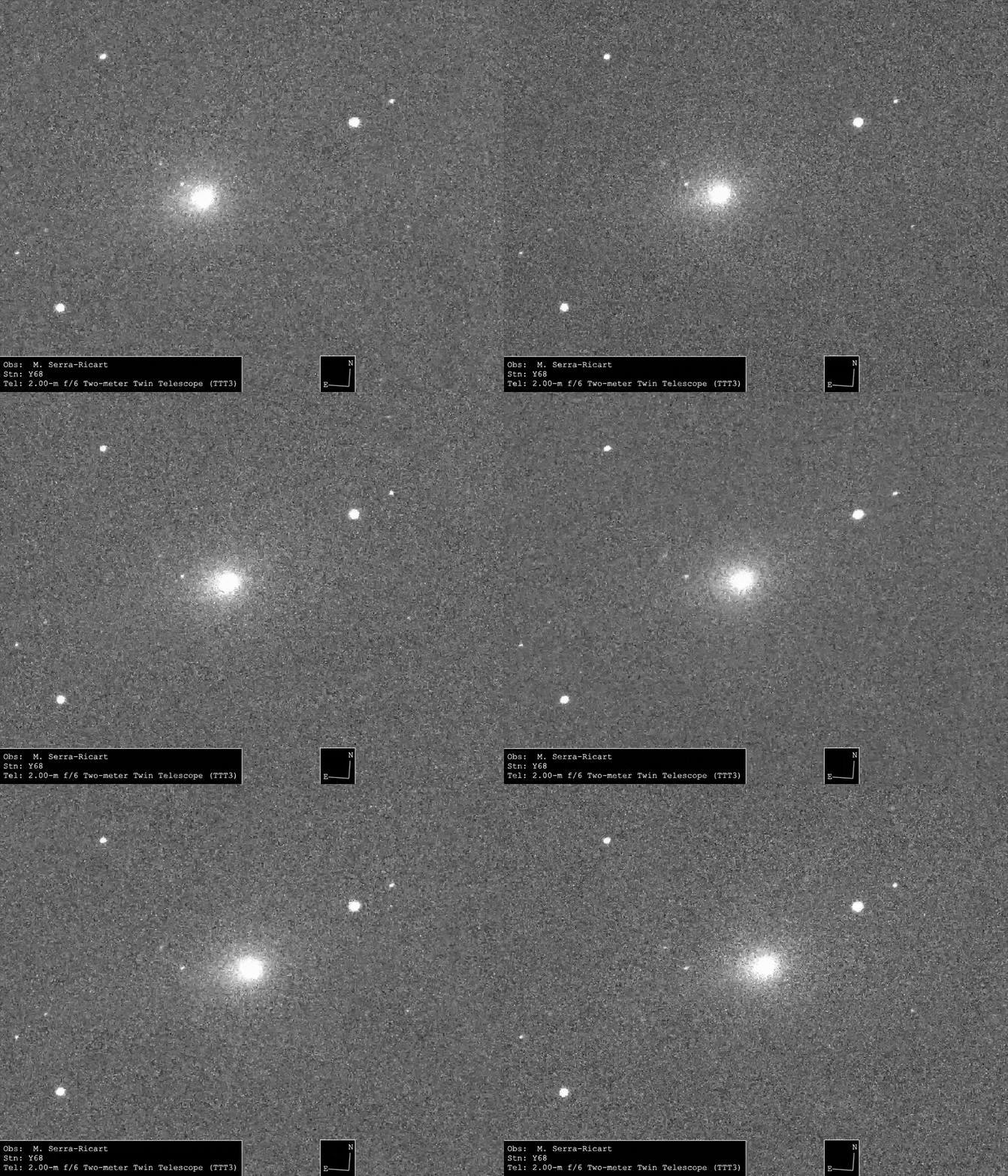
Comet 3I/ATLAS rapidly traverses the Solar System.
Credit: Miquel Serra-Ricart / Light Bridges
The Green Bank Telescope has remarkable sensitivity, being capable of detecting transmitters with extremely low power, on the order of 0.1 watt. For comparison, a cell phone emits about 1 watt. This capability rules out the presence of transmitters, even very discreet ones, on the object's surface. The team explored a wide range of radio frequencies, thereby limiting the risk of missing a potential signal.
During the analysis, nine signals were identified, but all were ultimately attributed to terrestrial sources. Sophisticated filters allow human interference to be distinguished from possible extraterrestrial emissions, ensuring the robustness of the results. Benjamin Jacobson-Bell, from the University of California, noted that these checks remain essential, despite initially modest expectations.
Despite the lack of detection, 3I/ATLAS retains major scientific interest. As the third identified interstellar visitor, it provides valuable clues about the formation of comets outside our solar system. Astronomers continue to examine its characteristics to better understand large-scale cosmic processes.
In the future, observatories like the upcoming Vera C. Rubin should enable the discovery of many more. This accumulation of data will help determine which objects are typical and which might present interesting anomalies.

Comet 3I/ATLAS traverses a dense star field in this image captured by the Gemini Multi-Object Spectrograph in Chile. The colored streaks are background stars.
Credit: International Gemini Observatory/NOIRLab/NSF/AURA/Shadow the Scientist. Image processing: J. Miller, M. Rodriguez, T.A. Rector, M. Zamani.
This approach illustrates the relevance of maintaining surveillance of these cosmic objects. Each new interstellar visitor brings its share of discoveries, whether of natural origin or, perhaps one day, artificial. The search for technological signals remains a priority for scientists, guided by curiosity and the exploration of the unknown.
How do telescopes detect radio signals?
Radio telescopes, like the one at Green Bank, capture electromagnetic waves coming from space. Their large parabolic antenna collects these often very weak signals, which are then amplified and processed by computer. This technology allows the study of distant objects or the tracking of potential artificial emissions.
The performance of these instruments is fundamental: they can perceive extremely faint signals, similar to those from a very low-power transmitter. The Green Bank Telescope, moreover, operates in an area protected from radio interference, which increases the precision of observations and facilitates the filtering of terrestrial noise.
Astronomers use filtering techniques to separate signals of cosmic origin from human interference. By scanning a wide spectrum of frequencies, they reduce the chances of missing an emission. This rigorous method is indispensable for solid research in astronomy and the quest for life beyond Earth.