☄️ Apophis: the "God of Chaos" returns and will be visible to the naked eye in 3 years
Follow us on Google News (click on ☆)
The moment of its closest approach is expected around 21:45 GMT. At that moment, Apophis will be about 32,000 kilometers (nearly 20,000 miles) from the Earth's surface. Just before, its brightness will reach a maximum, allowing it to be observed without instruments from areas with dark skies in Europe, Africa, and western Asia. A similar close approach for an object of this size, roughly the size of the Eiffel Tower, occurs only once every several millennia.

This encounter represents major interest for scientists. Earth's gravitational pull could alter the asteroid's rotation and surface, thus delivering unprecedented information about its internal composition. For researchers, this configuration constitutes an unprecedented opportunity to examine these transformations in real time.
Several space missions are also preparing for this date. The European Space Agency is planning the Ramses mission, and NASA is reorienting the OSIRIS-APEX probe so it can observe Apophis after its Earth flyby. These projects aim to gather information on the alterations caused by its passage near our planet.
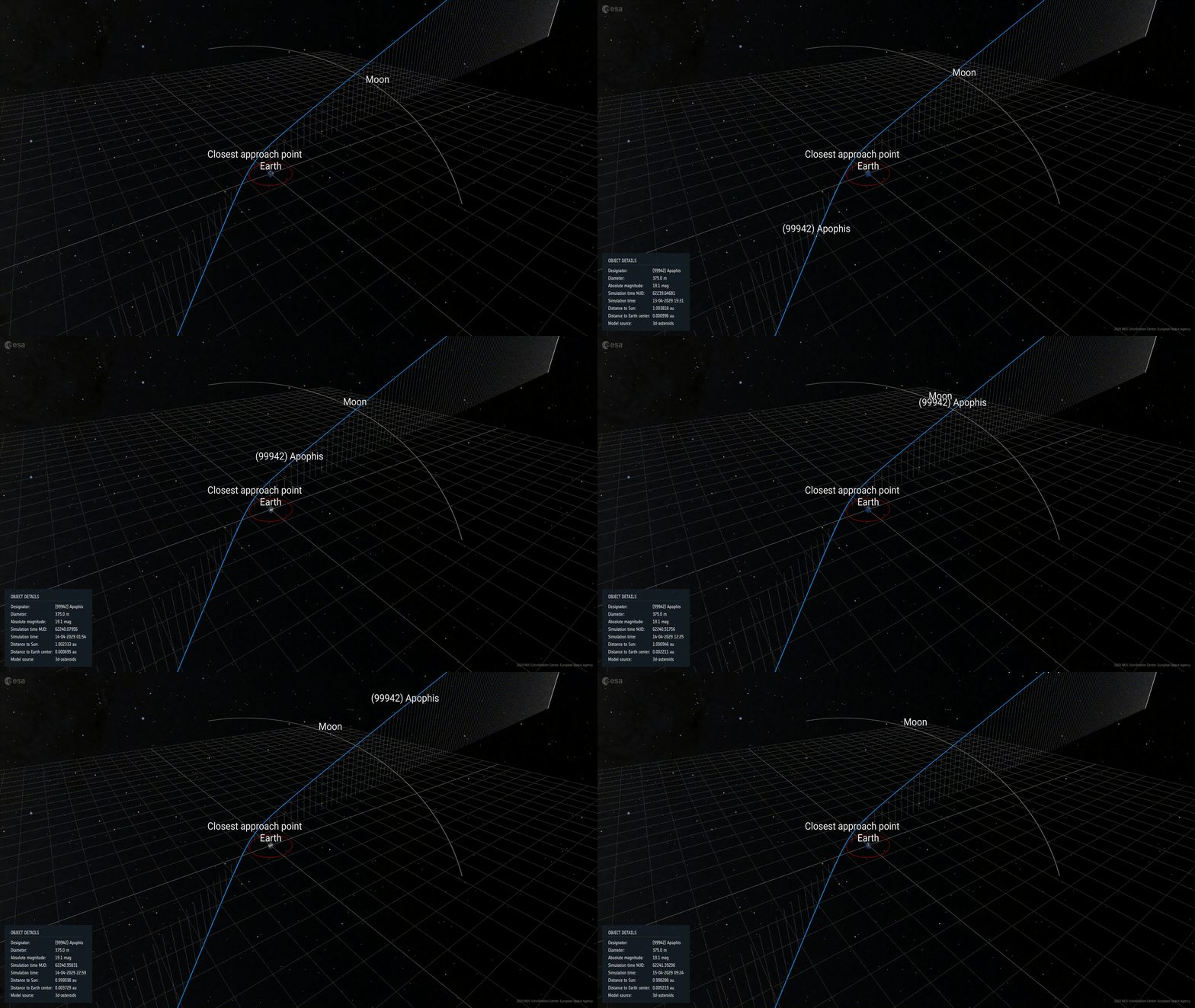
Animation showing the change in Apophis's orbit during its close approach to Earth in 2029.
Credit: ESA
Identified in 2004, Apophis initially raised concerns when calculations suggested a risk of collision, earning it its name, borrowed from an Egyptian deity of chaos and destruction. Radar observations have since ruled out any danger of impact for the next century, but the asteroid remains classified as potentially hazardous due to its size and the proximity of its orbit.
For enthusiasts, this approach represents an exceptional opportunity to discern the asteroid's movement across the starry vault in just a few minutes. Planning an observation from privileged sites, like the Canary Islands or North Africa, can increase the chances of benefiting from perfectly clear skies.

Artist's impression of ESA's Ramses mission to study Apophis.
Credit: ESA-Science Office
The event will allow us to increase our knowledge about near-Earth objects and planetary defense mechanisms. The measurements obtained will feed into the understanding of asteroid evolution during their close passes to planets.