⚫ First detection of a primordial black hole?
Follow us on Google News (click on ☆)
In the search for answers, a new path is emerging today with gravitational waves, these vibrations of spacetime predicted by Einstein. First detected in 2015, they constitute a tool for probing otherwise invisible phenomena, such as the collision of very dense objects. The recent analysis of a curious signal recorded by the LIGO gravitational-wave observatory provides an interesting, if not puzzling, clue.

The signal studied comes from a merger involving at least one very dense but less massive object than the Sun. A characteristic that goes against what is known about the smallest black holes, stellar black holes resulting from the collapse of supermassive stars, which are far more massive than our Sun.
Nico Cappelluti and Alberto Magaraggia, from the University of Miami, believe it could be a primordial black hole, a theoretical object born from density fluctuations just after the Big Bang. Their calculations, published in The Astrophysical Journal, show that such events would be rare.
Unlike stellar black holes, primordial black holes would have formed in the first instants of the Universe, with very different masses, ranging from that of an asteroid to that of a planet. This idea, put forward by Stephen Hawking in the 1970s, remains hypothetical, but their identification via gravitational waves could change everything. These objects do not interact with light, making them invisible, while possessing a mass that influences gravity.
This property makes them prime candidates for shedding light on the nature of dark matter, which constitutes about 85% of cosmic matter. Indeed, scientists struggle to identify this component, as it neither emits nor absorbs electromagnetic radiation. Confirming the existence of a sufficient number of primordial black holes could therefore fill this gap, offering an elegant solution, without resorting to exotic means, to a persistent question in astrophysics.
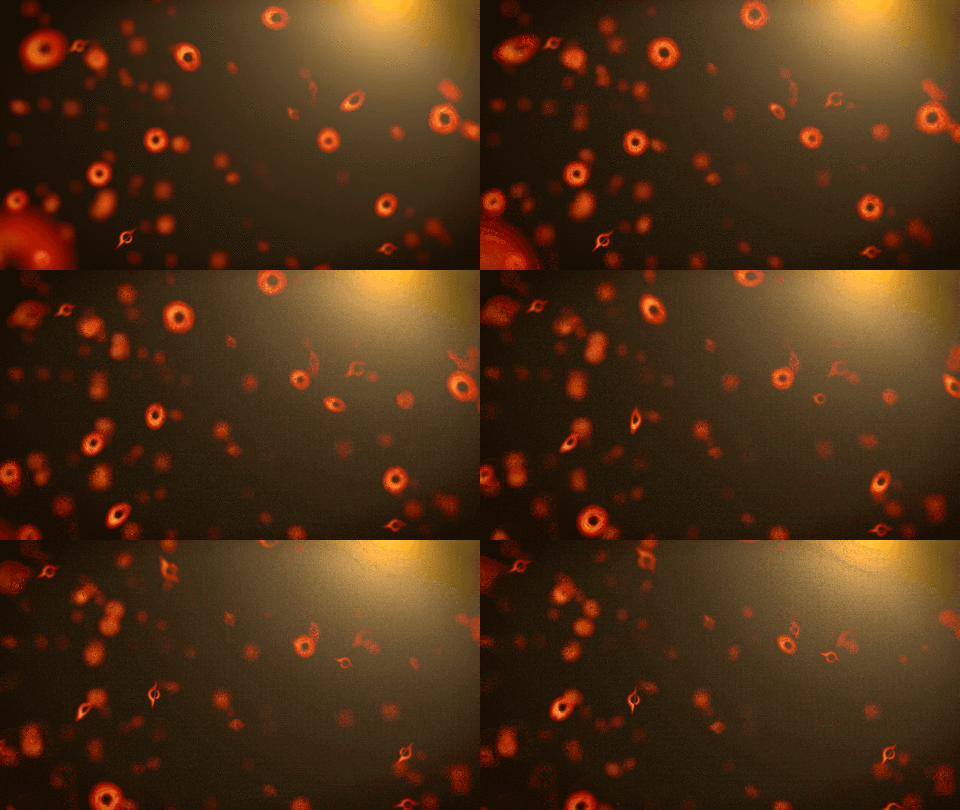
Credit: NASA's Goddard Space Flight Center
To consolidate this hypothesis, the detection of other signals of the same type is necessary. Future instruments, such as the LISA space observatory, will offer much greater sensitivity, allowing for an increased number of gravitational waves to be captured. Researchers note that patience is needed, akin to the quest that led to the first detection of gravitational waves ten years ago.