About 650 light-years from us, astronomers have detected 22 very faint arcs around the Helix Nebula. These shapes reveal fragments of stellar material disappearing into the surrounding space. Their appearance even makes it possible to estimate how long this phase lasts, which had previously been difficult to observe directly.
The Helix Nebula comes from a star that reached the end of its life, broadly comparable to the Sun in its overall evolution. It expelled much of its outer layers, leaving a small, very hot core at the center: a white dwarf. The expelled gas forms what astronomers call a planetary nebula, unrelated to a planet.
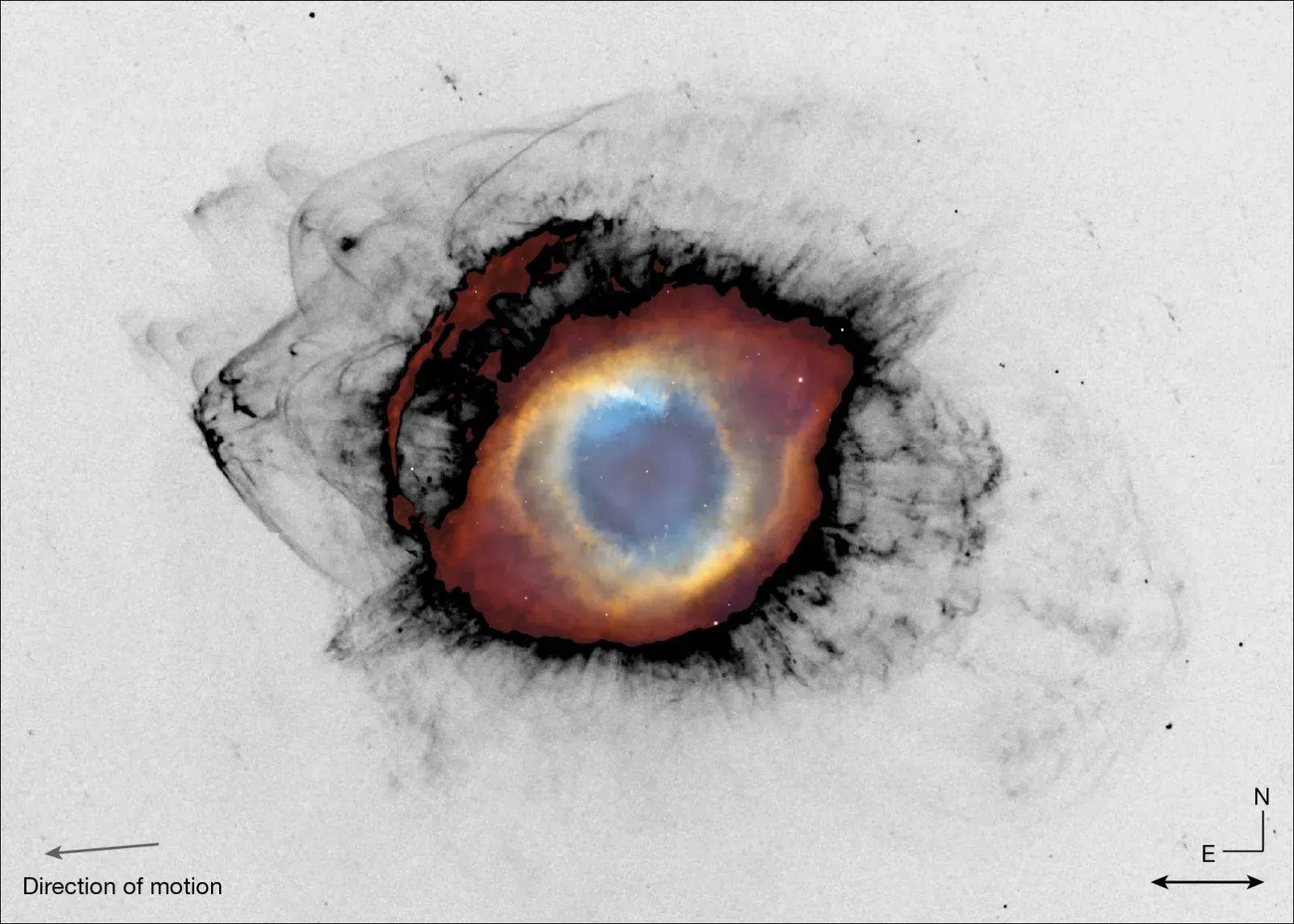
MOTHRA Hα imaging of the Helix Nebula.
The new arcs were detected using MOTHRA in Chile. Among other things, it observes light emitted by hydrogen. In the eastern part of the nebula, the researchers identified at least 22 complete or partial arcs. Most had never been described because this diffuse material shines extremely faintly.
To understand their origin, it is necessary to look at the motion of the system as a whole. The white dwarf is moving relative to the gas between the stars at about 36 km/s. The older ejected layers are also still expanding, at around 20 km/s according to the study. On the eastern side, their encounter becomes fast enough to produce shocks.
Each dense fragment then acts as an obstacle in a flow of gas. In front of it, the material is compressed and forms an arc, comparable to the curved wave in front of a boat. The researchers generally see no luminous object at the center of these arcs. The responsible fragment can therefore remain cold, dark and difficult to detect directly.
Another clue appears as one moves away from the central star. The nearby arcs are large, thin and well defined. Farther away, they become small, diffuse and irregular. The characteristic distance between the presumed fragment and the shock front decreases by a factor of about 30 between 0.4 and 1.4 parsecs from the star.
This progression corresponds to fragments that gradually lose their material. The surrounding gas slows them down, erodes them and then mixes their remains into the interstellar medium. Using their position as a timeline of their journey, the authors estimate their disintegration time at about 10,000 years. This measurement provides a direct reference for the rate at which stellar material is recycled.
This recycling supplies galaxies with gas, dust and elements produced during the lives of stars. Numerical models often have to represent this mixing without being able to track each fragment separately. Observations of the Helix now provide a measured duration for this stage. MOTHRA was still only partially assembled during these observations, leaving open the possibility of searching for even fainter structures with the completed instrument.