Follow us on Google News (click on ☆)
Unlike conventional rocket engines, this technology uses a continuous shock wave that rotates inside an annular chamber. The result: higher pressure and thrust, with reduced fuel consumption. Venus Aerospace, a company based in Houston, is behind a demonstrator in the United States.
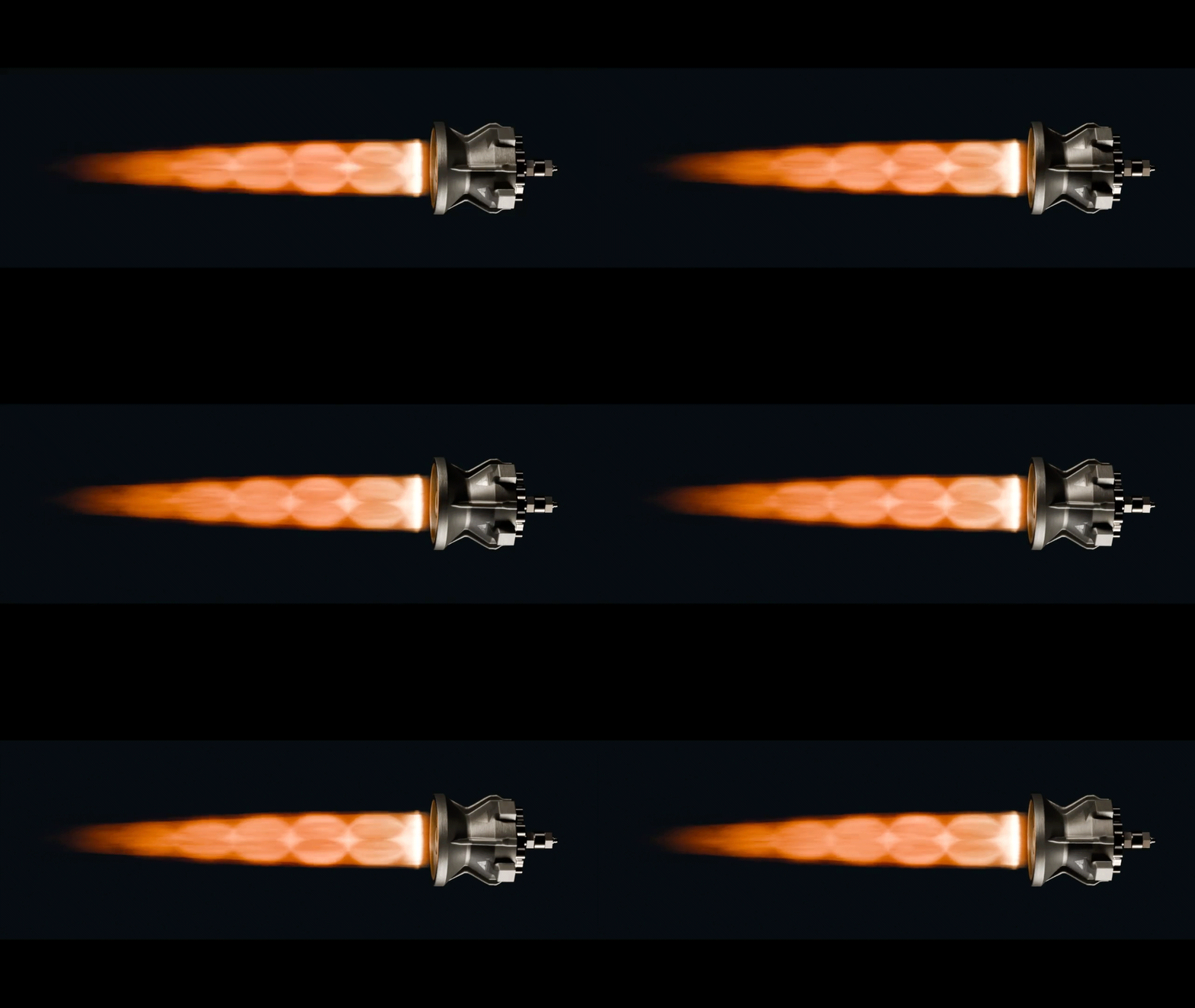
Venus Aerospace tests its rotating detonation engine.
Credit: Venus Aerospace
The operation of this engine, called RDRE (Rotating Detonation Rocket Engine), relies on detonation waves that circulate continuously. In a traditional engine, combustion is a relatively discrete process in comparison. Here, a series of continuous explosions propels the gases at supersonic speeds. Theoretically, this allows for much higher performance with better energy efficiency.
On May 14, 2025, Venus Aerospace conducted a test flight with its demonstrator. It was the first time an RDRE flew from American soil. The flight immediately drew the attention of investors and space agencies.
The company now announces the closing of a funding round of 91 million dollars. The round was led by Mercury Fund, a Houston-based venture capital firm, with participation from Lockheed Martin Ventures. Venus plans to use this money to transition its engine from prototype to an industrializable propulsion system.
The potential applications are numerous. The RDRE could power aircraft up to Mach 6 directly from takeoff, serve as an engine for orbital transfer vehicles, or equip lunar landers. The company also targets military and space uses, offering efficient and reliable propulsion.

Credit: Venus Aerospace
According to Venus leaders, the success of their engine lies not only in its operation, but also in its design, conceived for mass production and integration into real missions.
How does a rotating detonation wave work?
A detonation wave is a combustion reaction that propagates faster than the speed of sound. In an RDRE, this wave circulates continuously in an annular chamber, creating very high pressure. Unlike conventional engines where combustion is continuous but subsonic, here it is pulsed at high frequency.
This configuration allows for greater thrust while burning less fuel. The shock wave compresses the air/fuel mixture before it burns, increasing thermodynamic efficiency. The technical challenge is to stabilize this wave so that it does not extinguish or become uncontrollable.
Venus Aerospace also succeeded in maintaining this wave for a record time during ground tests, thus validating the feasibility of the concept for practical applications. This technology could reduce rocket fuel consumption by 20 to 30% compared to conventional engines.