After around ten flights kept on suborbital trajectories, Starship has just cleared the hurdle it needed to become a true orbital launch vehicle.
The 14th test flight lifted off on September 28 from Starbase, Texas. The 124-meter rocket consists of the Super Heavy booster and the Starship spacecraft mounted above it. Previous flights reached space, but their speed remained deliberately insufficient to stay in orbit around Earth.
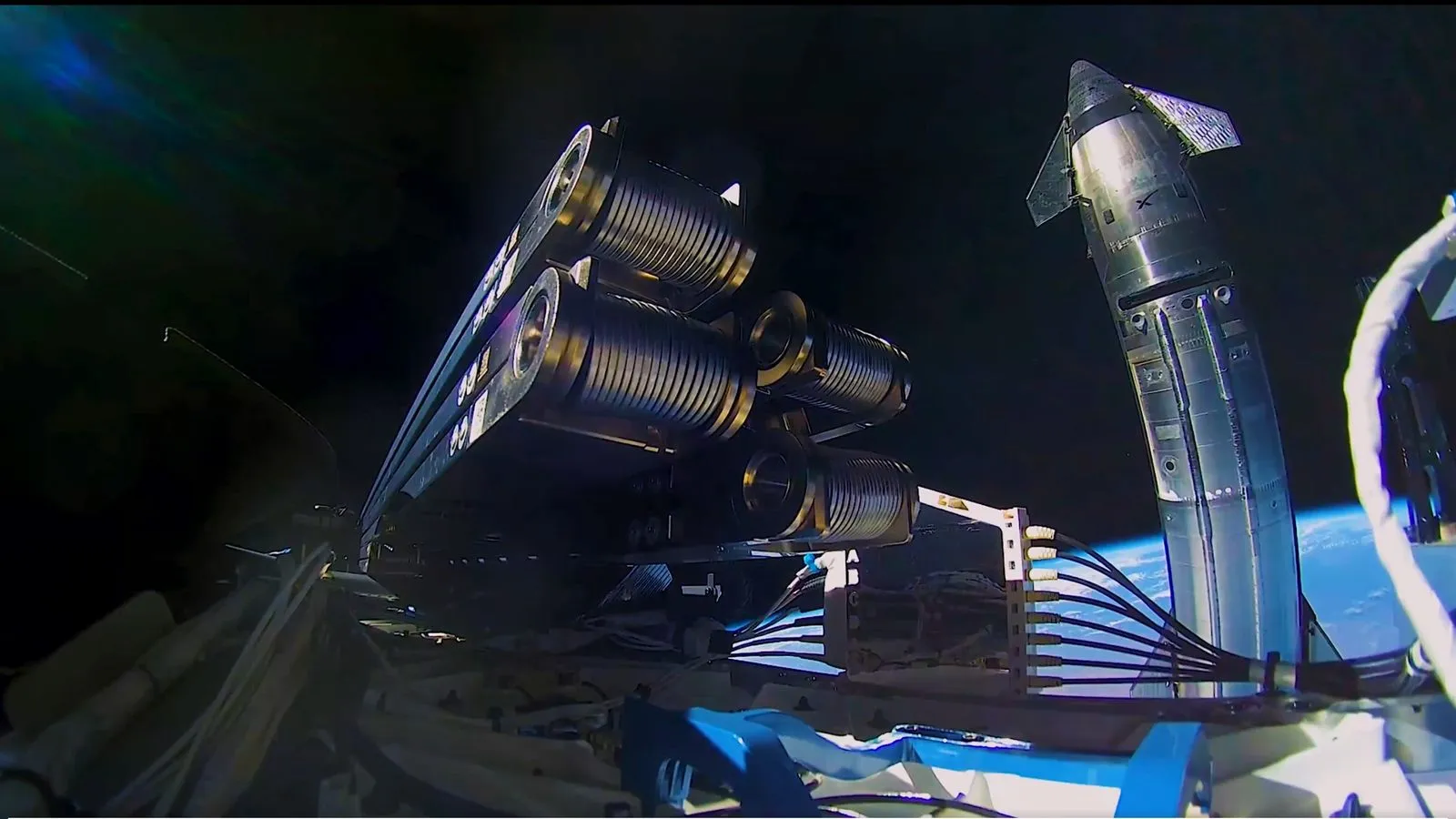
Starship seen from a freshly deployed Starlink V3 satellite during flight 14, with Earth in the background.
Credit: SpaceX
This time, the upper stage continued its ascent despite the premature shutdown of one of its Raptor 3 engines. The others compensated during the powered phase. After several minutes of checks, SpaceX authorized a restart in flight, needed to reach the final speed and stabilize the orbit.
The engine selected for this operation reignited for 19 seconds. Starship thus reached a low orbit at an altitude of around 276 km. In other words, it was no longer simply climbing very high: it was moving fast enough horizontally to continue circling Earth without immediately falling back down.
The spacecraft then deployed 26 Starlink V3 satellites. Each weighs about 2 tons, making them too large to fit inside the Falcon 9 fairing. SpaceX says each V3 can add up to 1 terabit per second of capacity to the network, approximately ten times that of a V2 Mini.

Starship performs its splashdown maneuver in the northern Pacific Ocean at the end of flight 14.
Credit: SpaceX
Super Heavy, for its part, made a controlled return toward the Gulf of Mexico and ended up in the water. The spacecraft was supposed to remain on a mission for nearly ten hours. SpaceX ultimately chose to bring it back after about three hours, as a precaution following the engine incident.
The deorbit burn proceeded as planned, after which Starship passed through the atmosphere and headed toward an area north of Hawaii. It tipped upright just before splashdown and then exploded. The vehicle was not intended to be recovered after this return over the ocean.
This flight above all changes the nature of the tests: Starship carried an operational payload into orbit. The launch vehicle is intended in particular for future Starlink deployments. An adapted version has also been selected by NASA to land astronauts on the Moon as part of the Artemis program.
The next tests must still validate longer stays in orbit, followed by the transfer of fuel between two Starships. This operation is required for the lunar missions planned by NASA. SpaceX is also preparing to return a Starship to its launch site, with recovery by the tower's arms.